8 AI visibility tools, from a first free look to the daily brand read (2026)
AI visibility tools for brand teams: start with a free AI visibility checker, then pick an AI visibility platform for daily tracking. 8 options compared.
By Ingrid Solberg, Brand Marketing Director ·
To see what AI engines currently say about your brand, run AI Results Tracker, a free AI visibility checker; for the monthly brand-health read, the AI visibility platform I’d pick tracks daily by default and files each answer by engine, market, and date: SE Visible by SE Ranking. For prompts sampled up to 100 times each, a sampling-led platform lower down goes deeper. The six other AI visibility tools each answer a narrower question.
How the machine describes us: in a September 2026 UK check, ChatGPT called the company “a safe pick for on-premise teams,” wording traced to a retired partner page predating our cloud move. Three sample prompts, one day. Yet in McKinsey’s survey of 500 European marketing leaders, branding ranked first for 2026, while gen AI and agentic AI came 17th of 20.
The route below: three limits of a single check, then the checker-or-platform question, a comparison table, and the eight AI visibility tools, card by card.
One free check is one draw, not a reading
A single free check carries less weight than it seems. A free AI visibility checker returns a snapshot: each engine’s latest answer to a few prompts. Answers vary between runs: a September 2026 preprint on brand discovery under repeated LLM queries finds one call recovered a median 80.0% to 92.5% of the brands five calls found in its February wave.
Read a single check for wording and sources. It’s a lead, not a finding.
The answer in one market isn’t the brand’s description everywhere
Engines answer per market, so buyers in Germany can read a different description than buyers in the US or in the UK. A brand selling in several countries has to read its AI search visibility one market at a time. We govern nine.
Even generative AI use differs across EU countries: about 48% of Danes overall used it in the past three months; in Italy, fewer than 20% of adults aged 25 to 64 did.
A description with nothing beside it: no rival, no history
A brand’s AI description is governable once dated and compared against rivals. In G2’s 2026 buyer research, about 8 in 10 B2B software buyers sourced recommendations from AI tools, and AI chatbots (37%) nearly matched review sites (38%) for shaping shortlists.
Beyond a snapshot, an AI visibility tracker adds rivals and history. Then each misconception gets logged: owner, cause, fix, recheck date.
Free AI visibility checker or AI visibility platform: which does a brand team need?
A free AI visibility checker shows what is being said about the brand in one market, on one day. An AI visibility platform shows how that description moves, where, and against whom. A brand team needs both, the check first.
What I check in AI visibility tools before trusting a figure:
- Wording: can I read the full answer behind the mention?
- Repeat: how many runs sit behind each figure?
- Market: can I set a country, city, or region?
- Rivals: who is named beside us, topic by topic?
- Record: is each answer kept with engine, market, and date?
Method: pages for all eight AI visibility tools read October 16, 2026; free check run on our brand.
The eight compared on what a brand owner actually reads
Read the Role column first: these AI visibility tools run from a free snapshot to seven ways of tracking the description.
| # | Product | Role | Markets | What you read | Pricing |
|---|---|---|---|---|---|
| 1 | AI Results Tracker | Free first look | 1 of 8 countries | Excerpts, cited sources | Free, 3 checks daily |
| 2 | SE Visible by SE Ranking | Dated description tracking | Country, city, or region | Stored answers, rivals | Published plans, free trial |
| 3 | Peec AI | Perception checks | 1-3 countries, self-serve | Attributes, objections | $95-$495/mo |
| 4 | Brandlight | Portfolio view | Multi-region, multilingual | Brands by region | Demo only |
| 5 | Evertune | Sampled benchmarks | Not published | 100 samples/prompt (Pro) | $60-$800/mo, annual |
| 6 | Hootsuite LLM Insights | Listening-suite perception | Not published | Perception over time | Demo; Lumen add-on |
| 7 | Brand24 Chatbeat | Mentions beside answers | Confirm in trial | Citing sources, context | From $199/mo annual + add-on |
| 8 | Gauge | Answer volume | One location (Growth) | 108,000 answers/month | $599/mo |
Prices for the competing AI visibility tools as of October 16, 2026.
The 8 AI visibility tools, in the order a brand team meets them
First the free look, then the platforms, each AI visibility tool matched to its problem.
1. AI Results Tracker
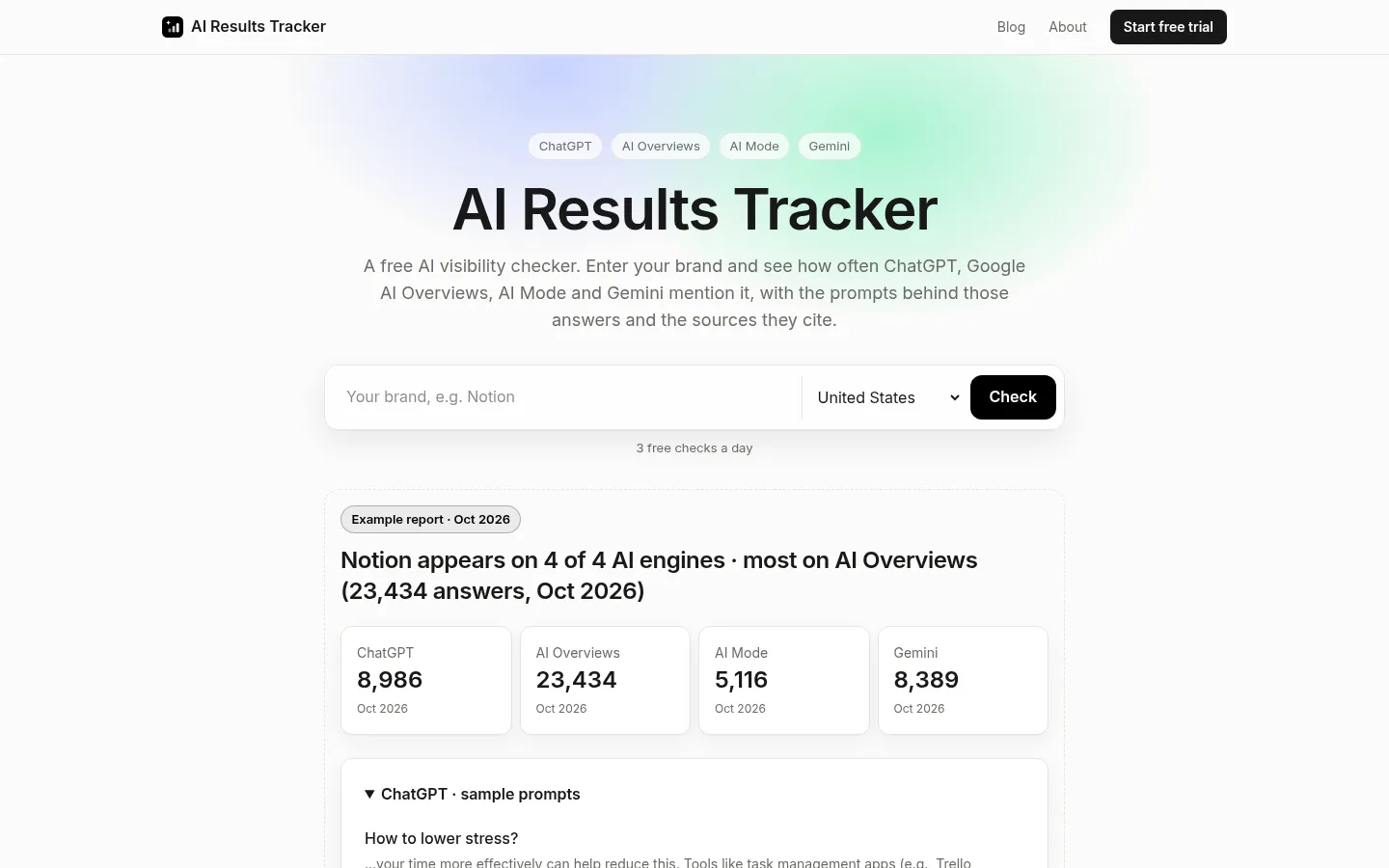
AI Results Tracker is a free AI visibility checker. Enter a brand and a country, and it shows how ChatGPT, Google AI Overviews, AI Mode, and Gemini mention it.
Best for: a same-day read of four engines in one market.
Standout feature: the words around the mention: per engine, three real sample prompts whose answers name the brand, an excerpt with the brand highlighted, the cited sites, and the data date.
Pros:
- Runs three free checks a day, no account
- Covers eight countries, US to India
- Counts mentions per engine, with monthly search volume per sample prompt where available
Cons:
- Reads the latest snapshot only, no history
- Shows three sample prompts per engine
- Matches by name, so common-word brands need the excerpt
Pricing: Free, three checks a day, no account.
The description check: the right first move. Run a snapshot for your own brand to read the wording and sources. The site itself says a snapshot isn’t tracking; the tracking platforms start with the next card.
2. SE Visible
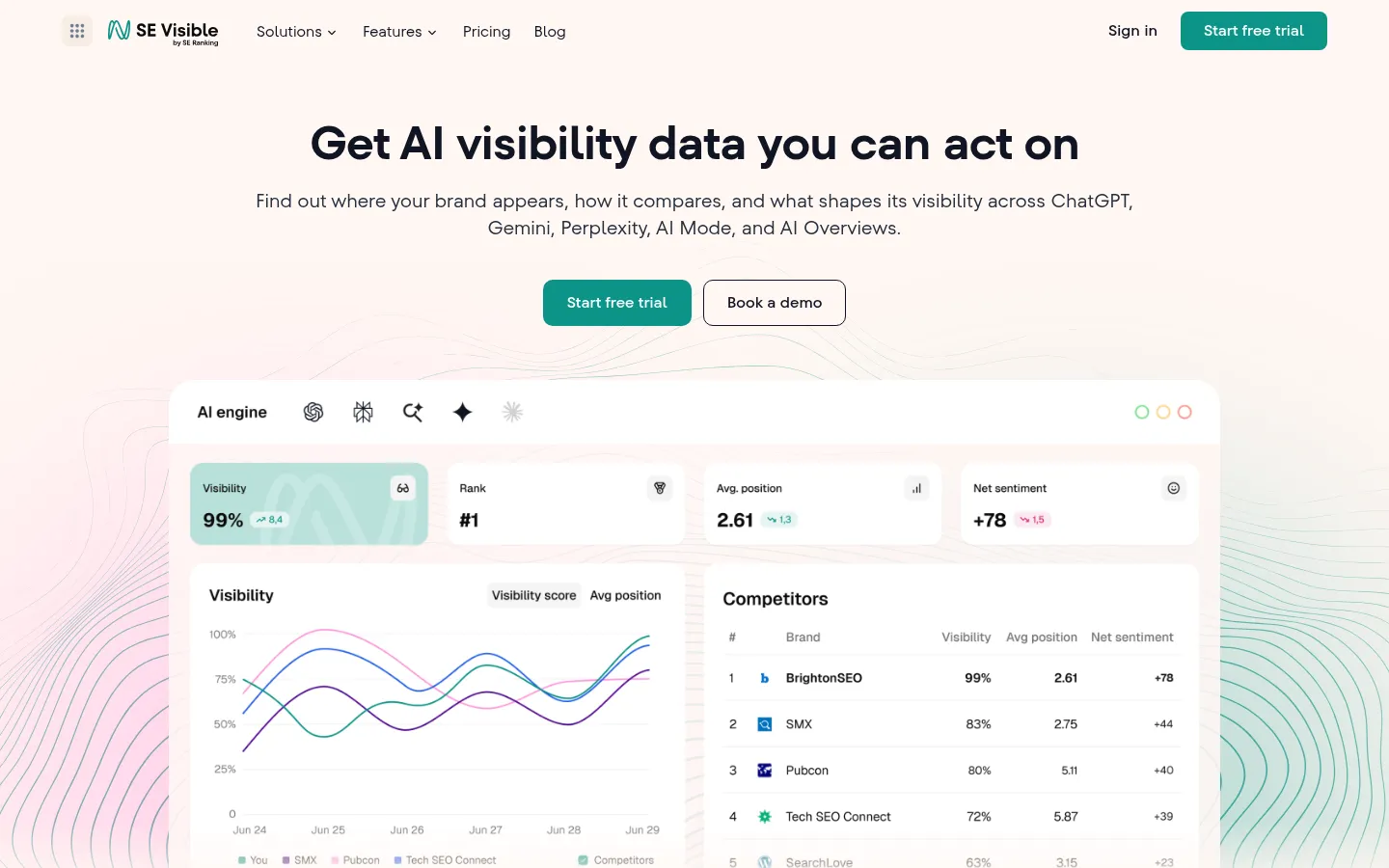
Net sentiment, from -100 to +100, shows whether AI answers describe a brand warmly or coldly, engine by engine. SE Visible by SE Ranking records how a brand is described by ChatGPT and Gemini and in Google AI Mode and Google AI Overviews. It’s an AI visibility platform, tracking daily by default.
Best for: in-house brand and communications teams where the AI description has a named owner, a budget line, and a place in executive reporting; also agencies serving clients.
Standout feature: a dated, recheckable record. Each answer is captured in the engine’s own interface through a real browser session, then kept unedited alongside its engine, market, and date. Average position, net sentiment, share of voice, and visibility score all open into the answers behind them, so a wording change can be read and dated.
Pros:
- Checks daily by default (adjustable in project settings), with a trend line per engine
- Sets the market as a country, or as a specific city or region
- Places suggested competitors beside the brand, topic by topic
- Scores sentiment per mention and lists cited domains and URLs, filterable by whether they name the brand
Cons:
- One market per project today; several countries in one project is planned
- Building reports inside the app is still in development; heavier reporting goes through Looker Studio, CSV and XLSX files, or the API (on all plans)
- Claude support is planned while the platform keeps growing
Pricing: visible.seranking.com publishes the plans; each carries all tracked engines and API access, and there’s a free trial to start.
The description check: if the description must sit in a monthly read with a date, an owner, and a recheck, this is the platform I’d run it on. Load your category prompts into SE Visible’s dashboard and watch each engine’s wording move.
3. Peec AI
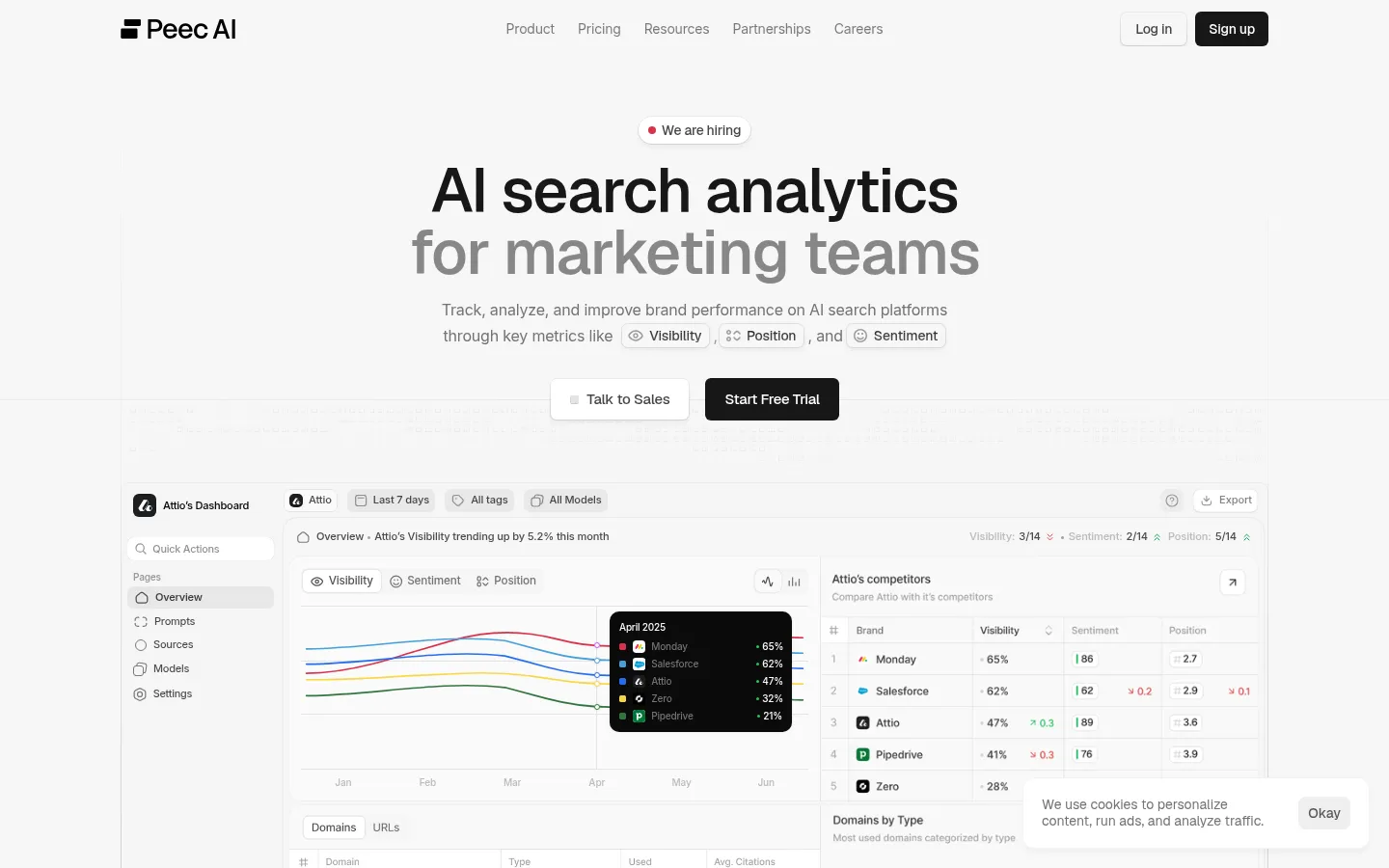
Peec AI sells itself as AI search analytics for marketing teams, with visibility, position, sentiment, and share of voice tracked daily against competitors.
Best for: marketing teams wanting self-serve daily tracking with a brand-perception view.
Standout feature: a Brand Perception section on Peec’s plan comparison: attribute scoring (what AI says you’re known for against where you place), recurring objections traced to the pages behind them, and prompts fact-checked against facts you set. Confirm the tier in a demo.
Pros:
- Includes unlimited users on every plan
- Tracks daily from Starter
- Adds multi-country tracking and Looker Studio on Advanced
Cons:
- Self-serve plans track three models of your choice; Enterprise goes up to 13
- Lists API access and SSO on Enterprise
Pricing: $95/mo Starter, $245/mo Pro, $495/mo Advanced; Enterprise custom, annual.
The description check: the closest of these AI visibility tools to a fact-check of the description. Ask which plan carries it first.
4. Brandlight
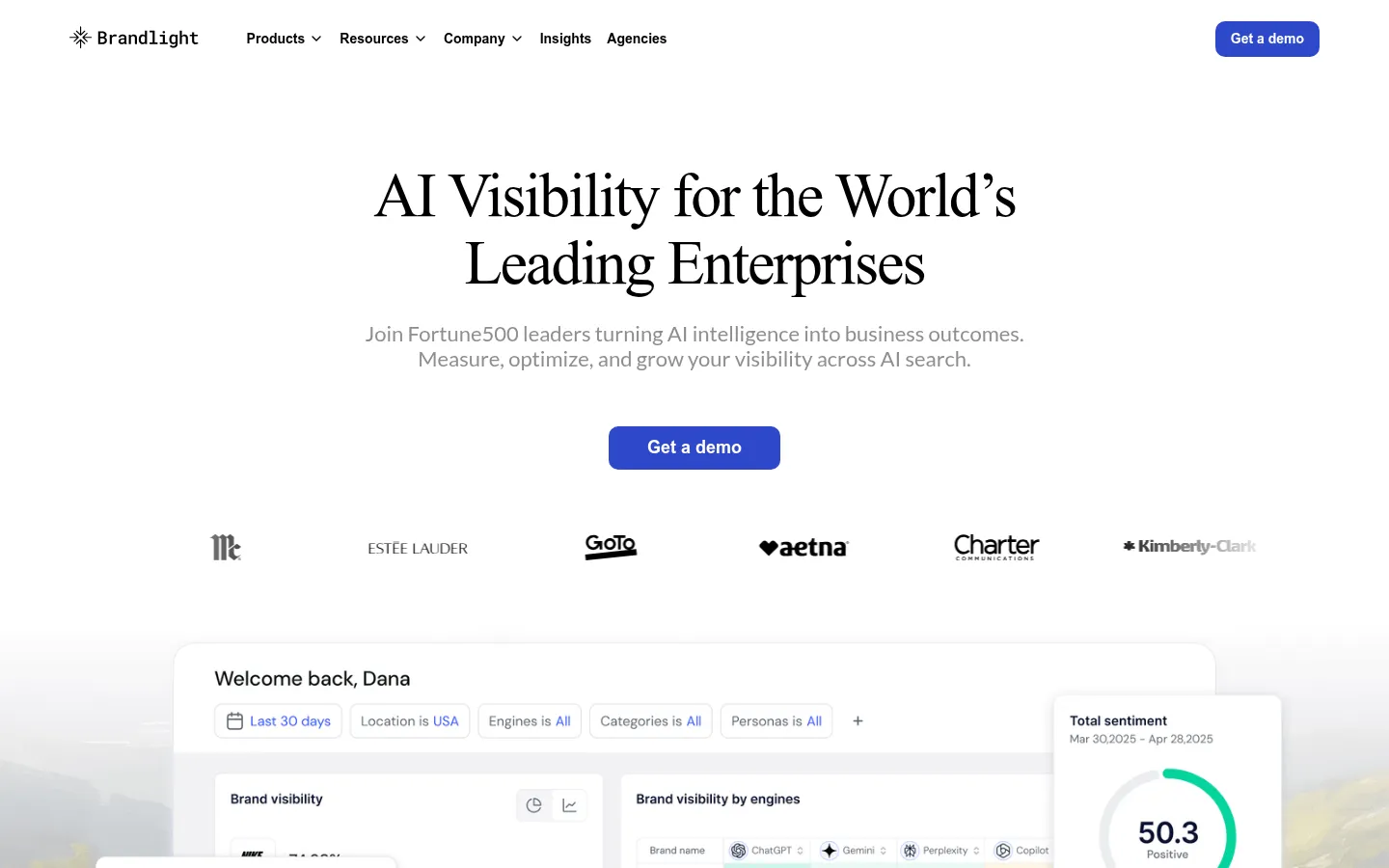
Brandlight is an AI visibility platform sold to enterprise brands, organized around one global view of brands, regions, and AI engines.
Best for: global brand organizations that need several brands and regions read in one place.
Standout feature: the Enterprise HQ View, which the vendor says consolidates performance across all brands, regions, and AI engines. A partnerships module shows which third-party publishers shape AI results.
Pros:
- Deploys multi-region and multilingual, with SOC 2 Type II (vendor-stated)
- Reports sentiment, source impact, and mention frequency
- Pairs accounts with white-glove support from an AI strategist
Cons:
- Publishes no pricing; access runs through a demo
- Doesn’t list tracked engines in its page text, so confirm them in the demo
Pricing: Demo and custom quote only.
The description check: built for the portfolio question of nine markets and several brands. Budget the sales cycle, and ask how AI search visibility in one market is kept apart from another market’s.
5. Evertune
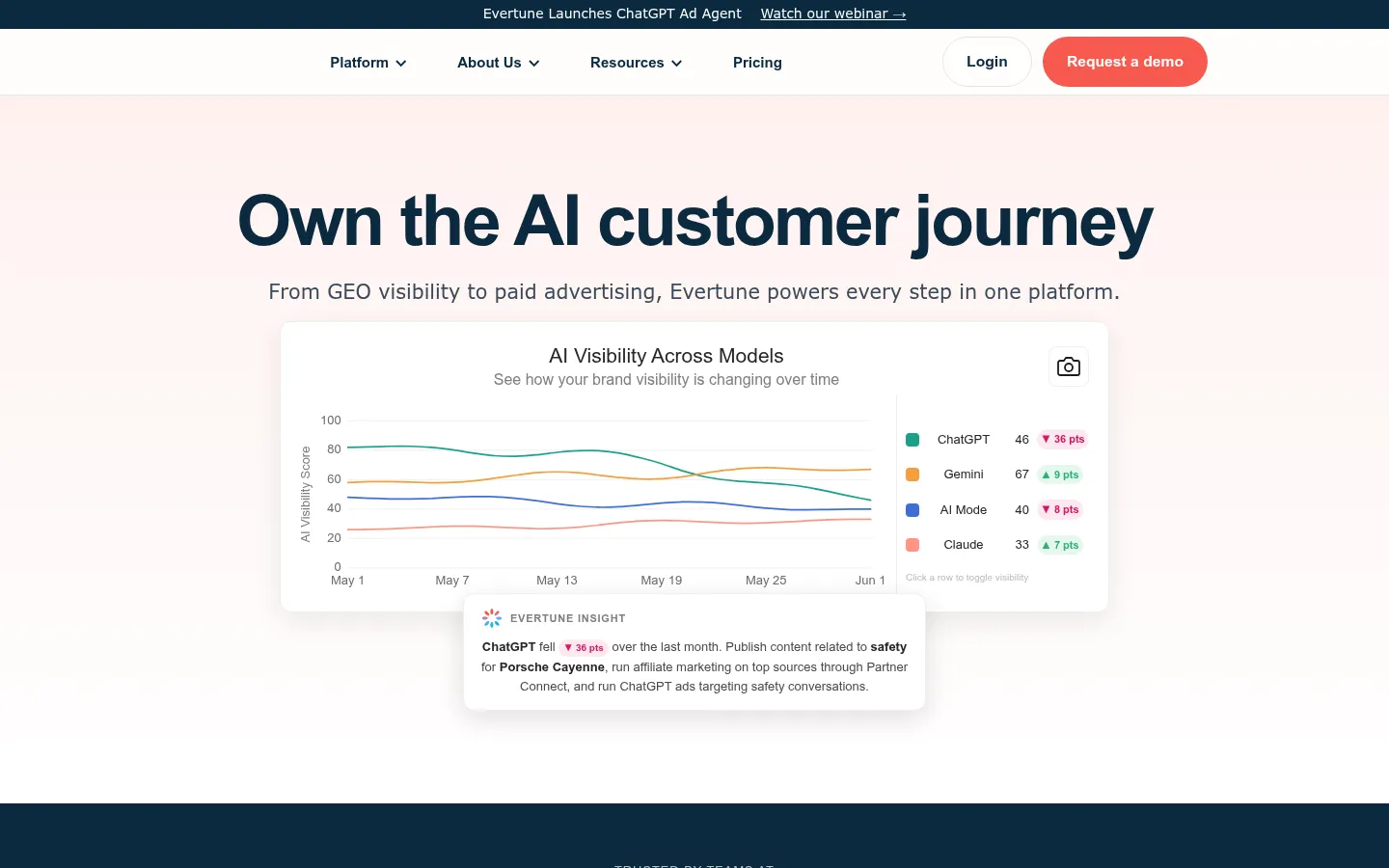
Evertune calls itself the marketing platform for brand discovery in AI search, from organic visibility to paid placements.
Best for: brand leaders who want sampled numbers before reporting a shift.
Standout feature: Pro and Enterprise put each prompt to 11 models, up to 100 samples apiece, and benchmark the brand against category competitors. Prompts are grounded in EverPanel, a panel of over 150 million user prompts.
Pros:
- Runs daily monitoring and competitor benchmarking from Starter
- Adds prompt research and data download on Pro
- Lists Fact Checker and SSO on Enterprise
Cons:
- Keeps the 100-sample runs for Pro; Starter tracks up to five models
- Prices its ad tools as a share of media, which a description brief may not need
Pricing: $60/mo Starter and $800/mo Pro, both billed annually; Enterprise is custom.
The description check: the strongest answer among these AI visibility tools to “is this one draw?” Make sure your plan is the one that samples.
6. Hootsuite LLM Insights
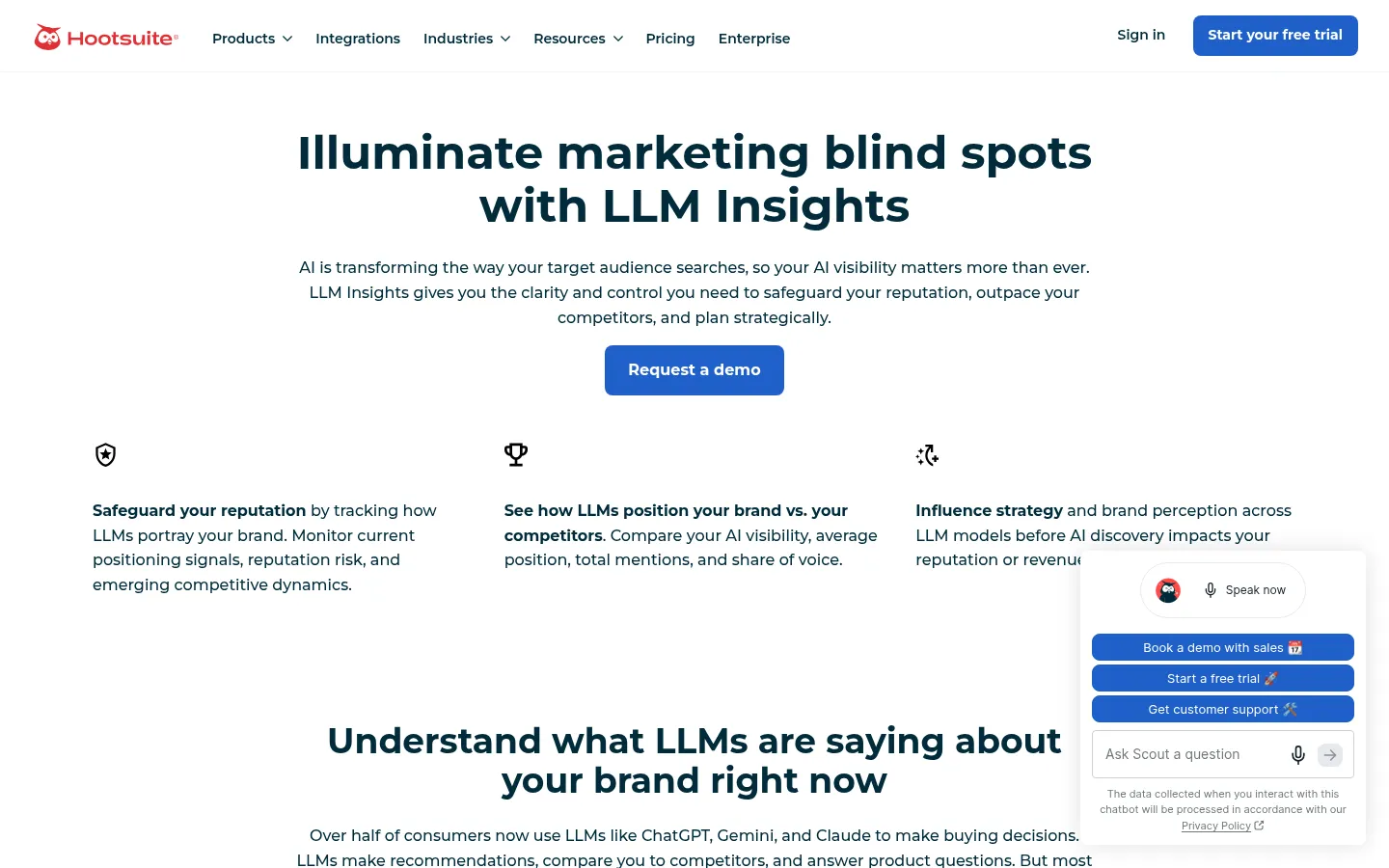
Hootsuite LLM Insights tracks brand perception in LLM answers; Hootsuite Lumen customers add it on, and Lumen by Talkwalker includes it.
Best for: enterprise social and insights teams already on Hootsuite Lumen or Lumen by Talkwalker.
Standout feature: it follows how LLMs describe the brand as models change, with built-in AI summaries explaining shifts in perception, plus misinformation and narrative-gap flags.
Pros:
- Compares AI visibility, average position, total mentions, and share of voice with competitors
- Offers prompt templates by goal, such as brand monitoring and risk detection
- Filters results by model, so each model can be read alone
Cons:
- Isn’t sold standalone; it lives inside the Lumen products
- Lists no tracked engines or pricing on its page
Pricing: Demo only; Hootsuite Lumen add-on or included in Lumen by Talkwalker.
The description check: sensible if listening already lives in Lumen. Read the summaries with the answers open beside them, not in place of them.
7. Brand24 Chatbeat
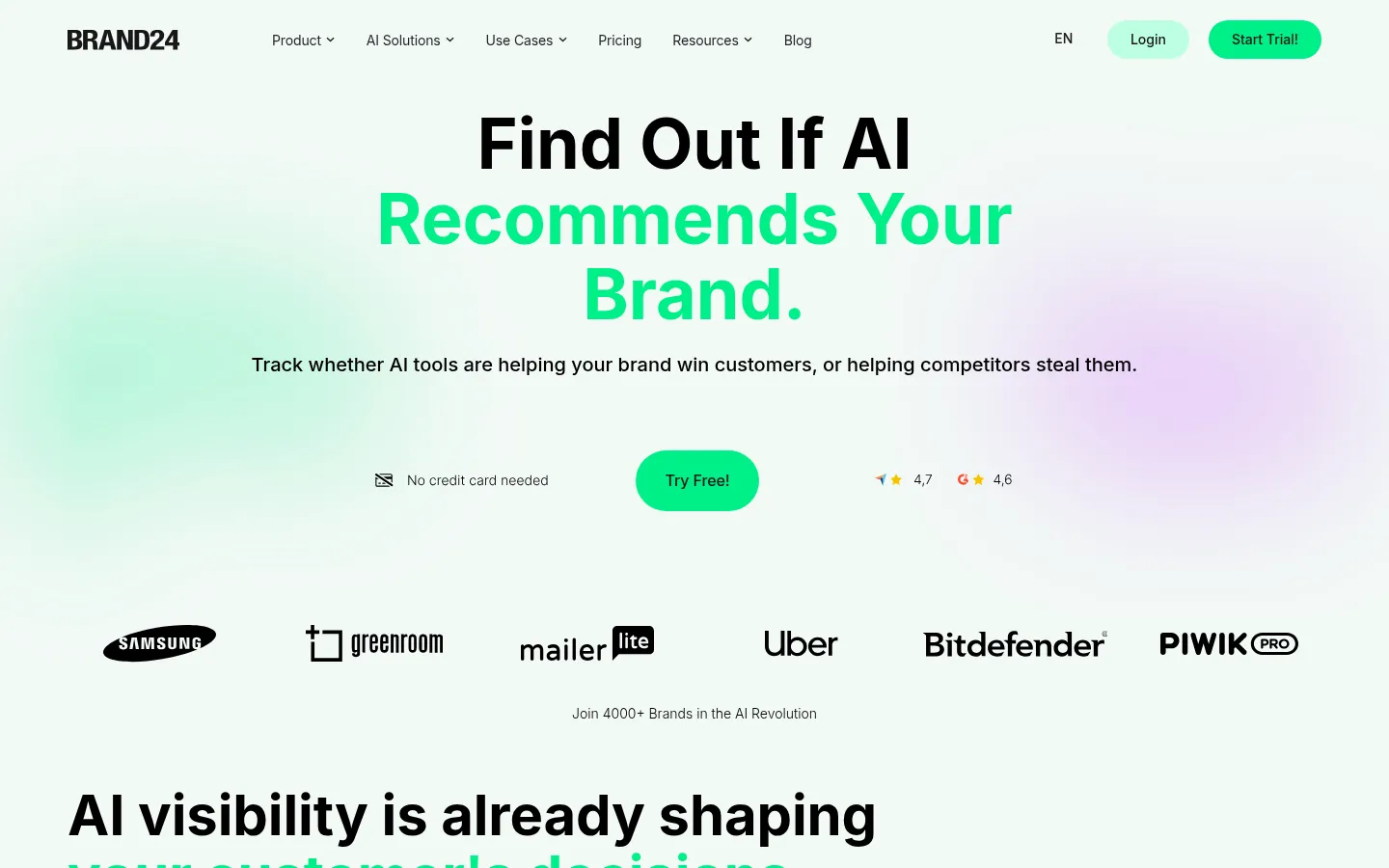
Brand24 monitors mentions across 25M+ sources; its companion Chatbeat shows how the brand appears in AI answers.
Best for: brand and PR managers who want web, social, and review mentions beside the AI answers built from them.
Standout feature: the pairing: Brand24 tracks what people praise, question, and compare across social, news, forums, and reviews; Chatbeat shows the AI answers, cited sources, sentiment, and how the brand is described.
Pros:
- Names nine engines, including ChatGPT, Claude, Perplexity, Grok, and Copilot
- Lets you define brand, category, and competitor prompts
- Offers a 14-day free trial
Cons:
- Sells AI Visibility as an add-on on every Brand24 plan, price unpublished
- Charges extra for API on Pro and Business
Pricing: Brand24 from $249/mo ($199/mo annually) plus the AI Visibility add-on.
The description check: useful AI visibility monitoring when a wrong description starts in a forum or review. Check that both products sit under one contract.
8. Gauge
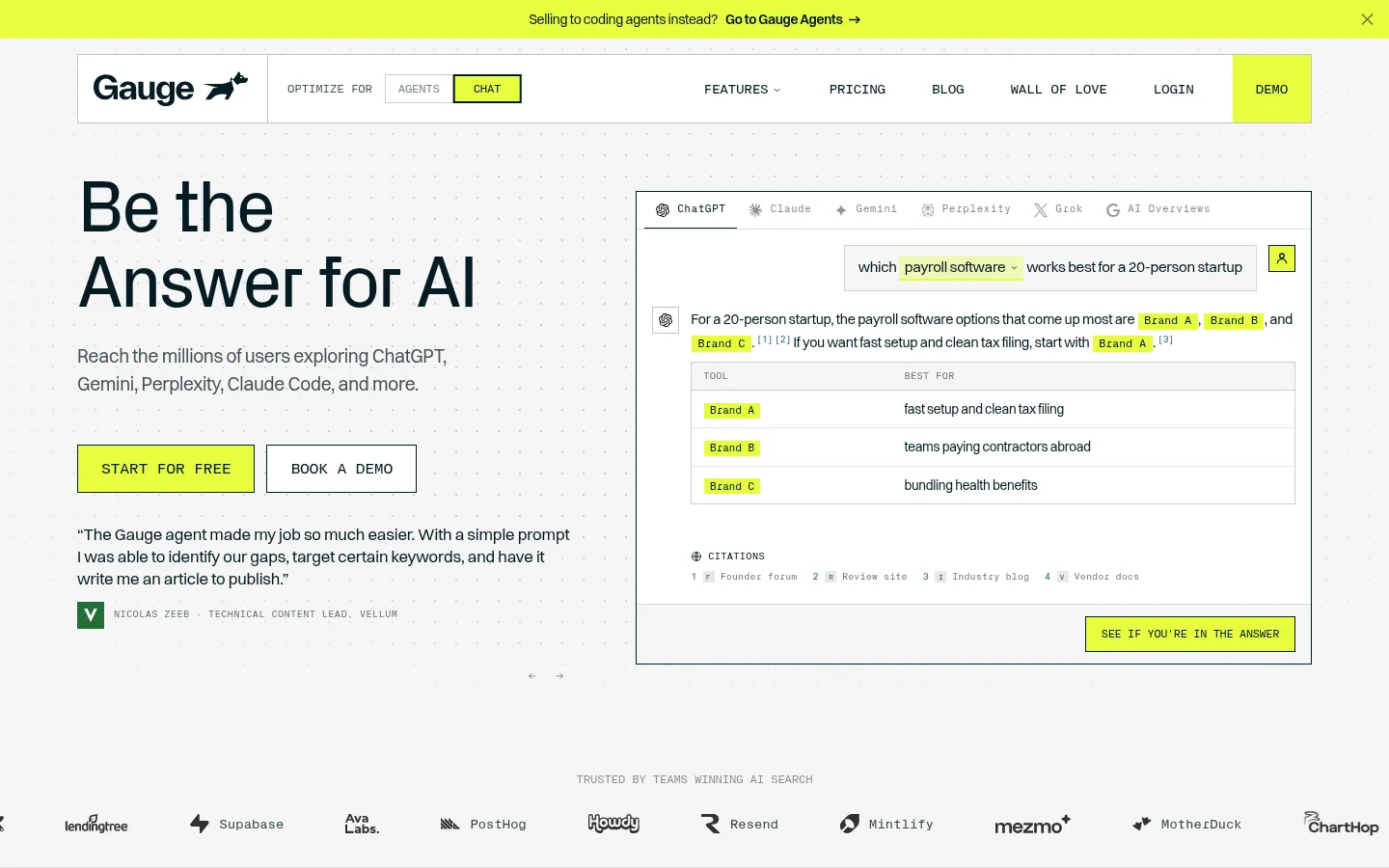
Gauge is an AI visibility tool that pairs daily answer tracking with a content engine in a single subscription.
Best for: growth-stage marketing teams that want high daily answer volume in one location, plus content production.
Standout feature: the volume is written on the plan. On Growth, 600 prompts run daily across six platforms (ChatGPT, AI Overviews, AI Mode, Gemini, Perplexity, Copilot), about 108,000 answers a month, with 18 publish-ready articles included.
Pros:
- Allows unlimited domains and competitors
- Connects GA4, Search Console, and DataForSEO
- Publishes to Webflow, Framer, Sanity, and GitHub
Cons:
- Covers a single location and five seats on Growth
- Needs your own API credentials for Claude and Grok below Enterprise
Pricing: Growth $599/mo; Enterprise custom.
The description check: when comparing AI visibility tools, a stated answer volume is easy to hold a vendor to. For a brand governing nine markets, the single location on Growth is the first question to raise in the demo.
What goes into the brand-health read
Which AI visibility tools does a brand team need? Two, in order: the free check for the wording and its sources, then one AI visibility tracker on a fixed prompt set per market, with a monthly recheck date and a named owner.
What changed for us: a free check at each market launch and a tracked set per market. The description is the brand now.
Skip if: you govern several markets on a one-location plan (Gauge Growth).
Trial two platforms on the same prompts for a month. If the description must be dated, compared with rivals, and rechecked monthly, SE Visible is the AI visibility platform for it: try SE Visible on your buyers’ prompts.
FAQ: checking and tracking how AI describes a brand
What are the best AI visibility tools for 2026?
It depends on the job. AI Results Tracker, a free AI visibility checker, gives a snapshot of how four engines mention a brand in one country. SE Visible is the AI visibility platform for tracking over time: daily by default, with stored answers and rivals. Sampled or portfolio platforms suit narrower briefs.
How do I check my brand’s AI visibility for free?
Enter your brand and one country in a free AI visibility checker such as AI Results Tracker, which allows three checks a day without an account. Read each engine’s excerpt around the mention and the sources it cites. Then repeat per market, on another day, before drawing any conclusion.
Which platform is strongest on AI visibility metrics?
No metric is better than its inputs, so judge each one by what sits behind it: stored answers, collection cadence, the market setting, and the rivals beside you. SE Visible opens net sentiment, average position, visibility score, and share of voice into the answers they came from.